
The Art and Science of D&O Underwriting: Why Technical Expertise Is Not Enough
Technical expertise, commercial and market skills, and operational excellence: why a complete D&O underwriter needs all three, especially in a prolonged soft market.
Technical expertise, commercial and market skills, and operational excellence: why a complete D&O underwriter needs all three, especially in a prolonged soft market.

When people think about underwriting, they usually think about the technical side of the job: analysing a risk, deciding whether to insure it, and then defining the terms and conditions.
That is, of course, an important part of the role. But it is not the whole job.
In D&O underwriting, we believe there are three areas that need to be developed in parallel:
Technical Underwriting Expertise
Commercial & Market Expertise
Operational Excellence
And mastering only one of them is not enough.
A very technical underwriter can still struggle if he or she does not understand the market, does not know how to negotiate, or is not able to build and maintain strong broker relationships.
In the same way, a very commercial underwriter can win business, but without the right technical discipline, this can lead to poor underwriting decisions.
And even a technically and commercially strong underwriter can run into problems if execution is weak, priorities are not managed properly, or the operational side is not under control.
The objective is therefore to develop the three areas in a balanced way.
Technical expertise is the foundation.
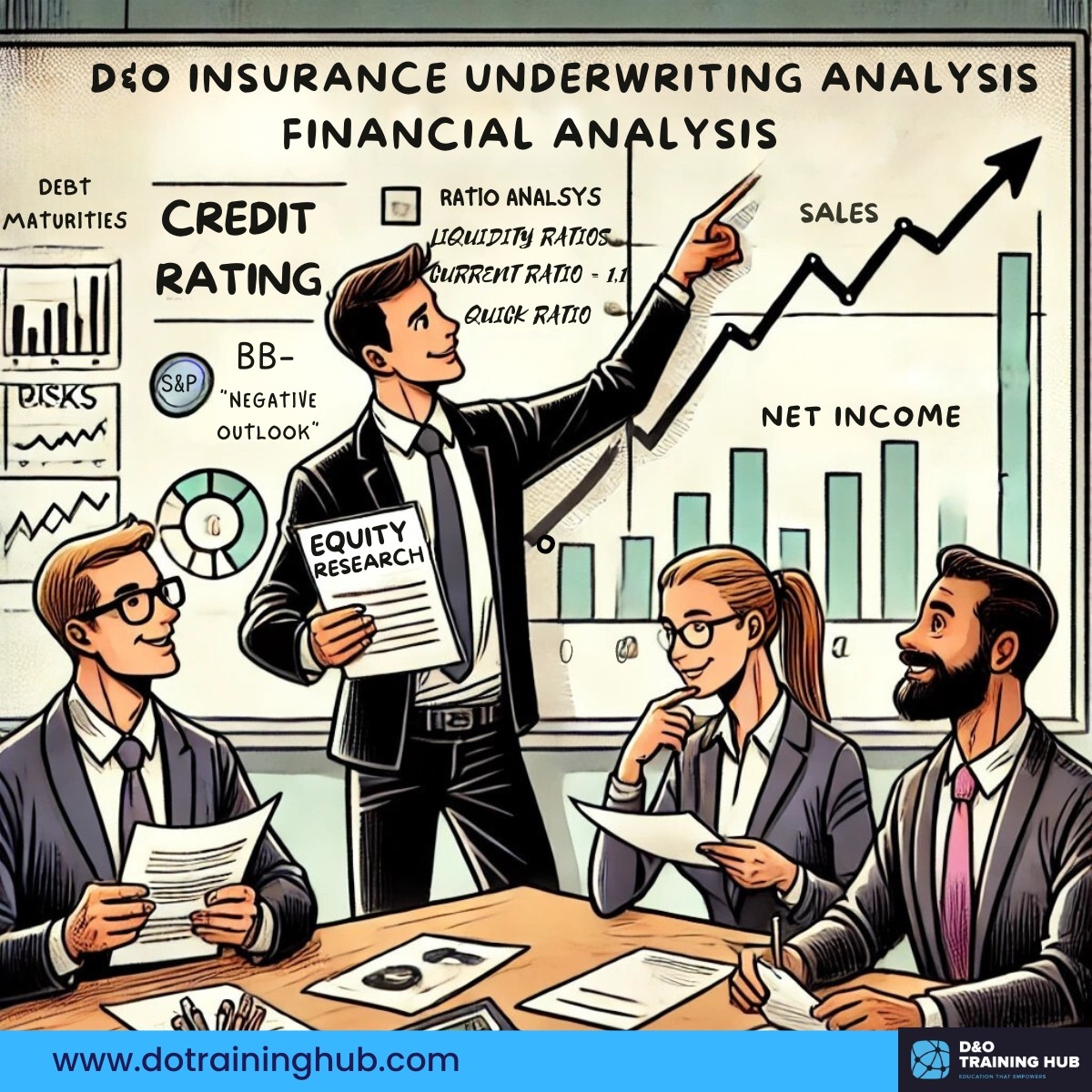
A D&O underwriter needs to understand the company, its financial position, governance, business strategy, potential sources of claims, and how the policy would respond.
This means having a good understanding of areas such as:
financial analysis;
corporate governance;
legal and regulatory issues;
D&O policy wording;
claims scenarios;
pricing;
portfolio management.
The objective is not to become an accountant, lawyer or claims handler.
The objective is to be able to connect all these elements and form a view on the risk.
What can go wrong? Who can bring a claim? Against whom? How severe could the situation become? What protection are we actually providing? And does the risk make sense within the insurer’s appetite and portfolio?
That is the core of the technical side of underwriting.
At the D&O Training Hub, this is the area where we have built most of our content so far. We already offer classes and masterclasses on different technical topics, including D&O coverage, financial analysis, claims, securities exposures, international programmes and other Financial Lines subjects.
Our objective is to help underwriters strengthen and refine this technical foundation.
But technical expertise alone does not make a complete underwriter.
The commercial side is sometimes underestimated in underwriting. But underwriters are not only risk analysts. They are also in the front line when it comes to developing business.
They work with brokers every day, negotiate terms, follow opportunities, defend renewals, and try to grow their portfolios.
In other words, underwriting is also a sales function, but it is a very specific type of sales. In insurance, selling is nuanced. If selling meant only lowering the price, it would be easy. But that is not the job.
The challenge is to find the right balance between what the client and broker want, and what fits with the insurer’s appetite and profitability objectives. That requires strategy. It also requires market intelligence.
Before quoting an important account, it is useful to understand much more than what is written in the submission. Why is the account in the market? Is the client happy with the incumbent? Who else is competing? What is the broker really looking for? Is price the main issue, or is it wording, capacity, service, or something else? What would make the broker place the business with us?
This additional information can make a real difference.
Good service is important. Being responsive is important. Having strong technical expertise is important. But competitors are also trying to provide good service and good terms. So when several insurers are credible options, what makes the difference?
Often it is how strategic and proactive the underwriter is:
calling the broker before or after a quotation;
showing that the account is genuinely of interest;
asking for feedback;
understanding what is preventing the deal from closing;
being flexible where it makes sense, but also knowing when to maintain discipline.
And, of course, not every account deserves the same level of effort. A key commercial skill is also knowing where to focus.
The best opportunities are usually those where three things come together: we like the risk, it fits our appetite, and we have a realistic chance of winning it. That is where underwriters should be willing to invest more time and energy.
This point is particularly relevant today. D&O has been in a prolonged soft market, with abundant capacity, strong competition and pressure on pricing and conditions.
In that kind of environment, technical competence alone is less likely to differentiate one insurer from another. There are many capable insurers in the market. There are many good underwriters. And there are many credible offers.
So the difference between winning and losing an attractive account can come down to how well the underwriter understands the placement, how effectively the relationship with the broker is managed, how clearly the appetite is communicated, and how intelligently the negotiation is handled.
This is why commercial and market skills are especially critical in a soft market. They are not secondary skills. They are part of underwriting. And they can be learned and improved.
The third area is operational excellence. This is perhaps the least glamorous part of the job, but it is essential.
An underwriting opportunity does not end when the quotation is sent. From the moment a submission arrives, the underwriter needs to follow the whole life of the account.
There is the analysis, pricing, internal referrals, quote, negotiation, binding, documentation, endorsements, changes during the policy period, invoicing issues, claims notifications, and eventually the renewal.
At the same time, there are broker meetings, internal meetings, portfolio reviews, management requests, new business opportunities and other priorities. So the job can become very busy very quickly.
This is why organisation, prioritisation and discipline matter so much. A strong underwriter should always know what needs to be done, what is urgent, what is strategic, what is waiting for information and what requires follow-up.
Understanding internal processes is also important. Company strategy, underwriting guidelines, authority levels, referrals, pricing tools, policy administration systems, document management and increasingly AI tools are all part of the job.
The better underwriters manage this side, the more time they can dedicate to the activities where they add the most value: analysis, relationships, negotiation and decision-making.
This is the main point. A D&O underwriter should not think of these three areas as separate. They constantly interact.
You can have a very good technical view of an account, but if you do not understand the market context, you may not position the offer properly.
You can have an excellent broker relationship, but if the risk does not fit your appetite, winning the account is not necessarily a success.
You can have both the right technical and commercial approach, but if you are too slow, badly organised or do not manage the internal process properly, you can still lose the deal.
This is why we like the idea of putting Underwriting Judgment in the middle of the three areas.
For us, underwriting judgment is the ability to bring together technical analysis, market intelligence, experience, commercial context and operational realities, and then make the right decision with the information available. That is really the heart of the profession.
At the D&O Training Hub, our main focus until now has been the technical side. We help underwriters and Financial Lines professionals develop and refine their knowledge through practical courses and masterclasses on D&O and related topics.
But we also want the Hub to reflect the reality of the job. And the reality is that technical knowledge alone is not enough. Underwriters also need to develop market knowledge, broker management, negotiation skills, commercial strategy, organisation and execution.
That is why we are now preparing a new class focused specifically on the Commercial & Market side of D&O underwriting. The objective will not be to turn underwriters into traditional salespeople. It will be to help them become more strategic when it comes to:
understanding the market;
selecting the right opportunities;
asking the right questions;
managing broker relationships;
positioning their offer;
negotiating;
following up;
learning from wins and losses.
In a competitive market, these skills can make a real difference.
Because in the end, the complete underwriter needs all three:
Technical Underwriting Expertise to understand the risk.
Commercial & Market Expertise to understand the market and win the right business.
Operational Excellence to execute consistently.
And the better these three areas are balanced, the stronger the underwriting judgment becomes.
That is, in our view, what makes the difference between knowing underwriting and really mastering the job.